
Coffee With Catt: Issue #10 | The Man with the Golden Gun
John Dorward has achieved two exits in two months from the gold companies he runs today, including Roxmore Resources’ US$464 million cash sale to SSR Mining.
I interviewed John to ask him:
Why do you always get your man?
With over twenty years of experience identifying, improving and selling mining assets, John explains what he looks for and how investors can position themselves, including a potential ‘bridesmaid’ that might be clutching the proverbial wedding bouquet.
Since I called the bottom in gold and silver miners on 10 July, here, my junior names that need market oxygen to survive have been slowly strangled.
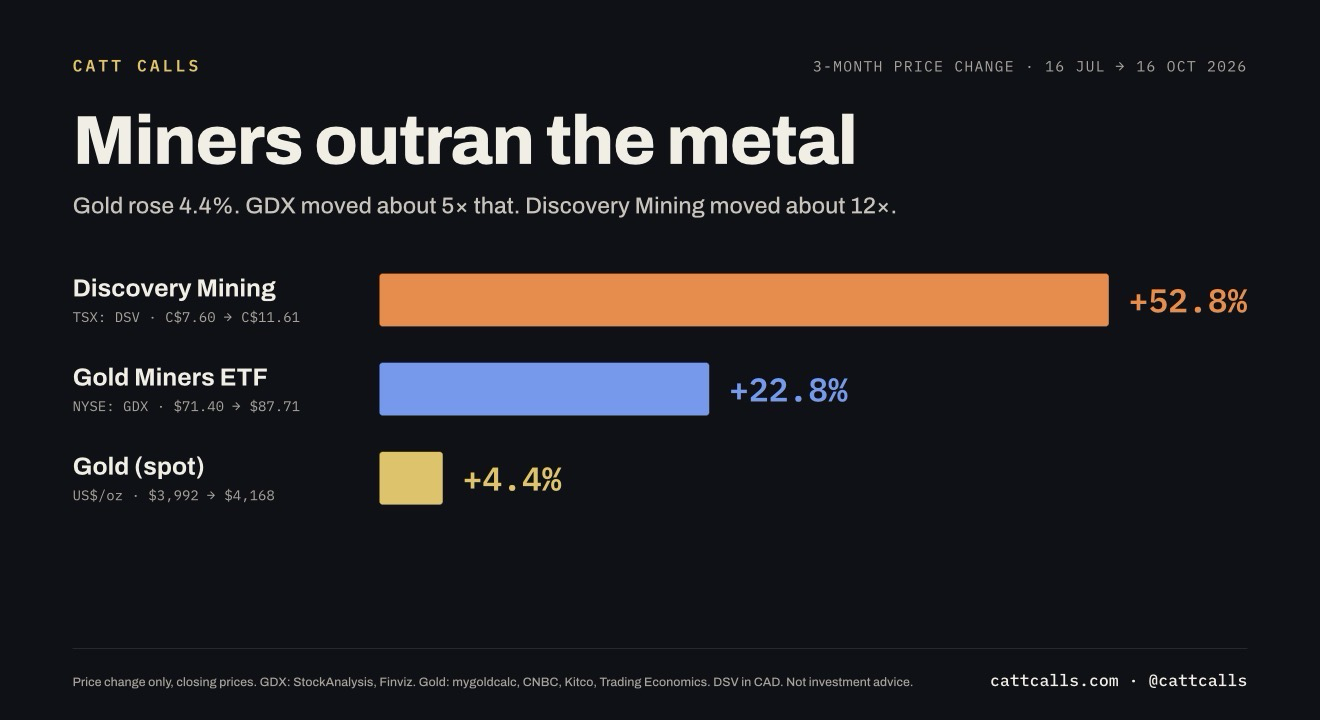
Producers with serious growth, like Discovery Mining (DSV:TSX), have outperformed gold by 12 times, while the GDX is about five times better.
Discovery CEO Tony Makuch now talks of the Porcupine gold mine complex, augmented by the Kidd Creek processing capacity recently acquired from Glencore, producing one million ounces of gold per year, up from today’s 300,000 ounces of annual production.
Demand is storytelling
Students of the market will enjoy an explainer on Capital Cycle Investing from Hosking Partners’ Django Davidson. Django covers why his firm, Hosking, is selling memory chips boosted by AI demand and buying platinum group metal and copper miners.
How to Profit When Cycles Turn – Django Davidson on Capital Cycle Investing
Inspired, I grabbed myself a copy of the 2026 Platinum Group Metal (PGM) ‘bible’, produced by Johnson Matthey, to find out about SUPPLY, which is mostly about what Russian PGM producer Norilsk is doing.
Norilsk produces 40% of global palladium and has historically supplied more if you include inventory destocking:
“We think that Norilsk Nickel has liquidated most of its palladium inventory in the past three years…this will result in a material fall in global primary palladium supply in 2026…”
“This year, PGM production at Norilsk Nickel is set to drop steeply. According to guidance, palladium output will be in a range of 2.42–2.47 million oz, which would represent a decline of 10–11% compared with 2025, and would be the lowest total since at least 2005.”
— Johnson Matthey
Nevertheless, Johnson Matthey forecasts a surplus of palladium supply over demand in 2026.
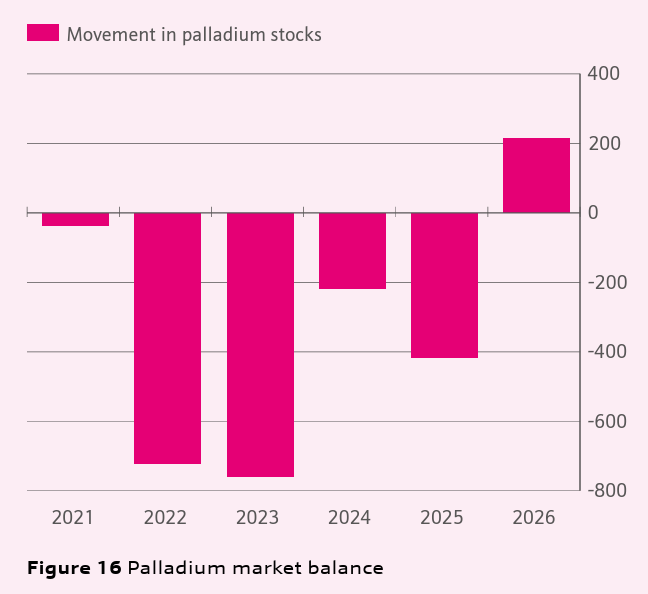
Palladium prices have fallen from around US$2,000/ounce at the start of 2026 to US$1,155/ounce at the time of writing. The most recent palladium demand disappointment has been this week’s news of a European quota of 350,000 on imports of Chinese vehicles to Europe.
Eighty per cent of palladium demand comes from auto catalysts, where the silvery metal is part of a cocktail in the vehicle exhaust to clean up emissions.
The cure for low commodity prices is low commodity prices. Palladium is no different.
This week in Perth, I caught up with Chalice Mining CEO Alex Dorsch, whose destiny is intertwined with palladium.
Chalice plans to generate revenue from palladium, copper, nickel and gold, in that order, from its Gonneville Project in Western Australia by the end of the decade.
Alex Dorsch discusses Chalice’s progress towards a build decision at Gonneville in 2028 at the Arlington Rapallo in September. Watch the interview here.
I bought myself a few Chalice (CHN:ASX) shares because I like the asymmetry of the palladium bet. After years of deficits, the exhaustion of Russian palladium stockpiles, materially lower Russian palladium output in 2026 and the chance of further palladium supply disruption, the risk to palladium prices is UP.
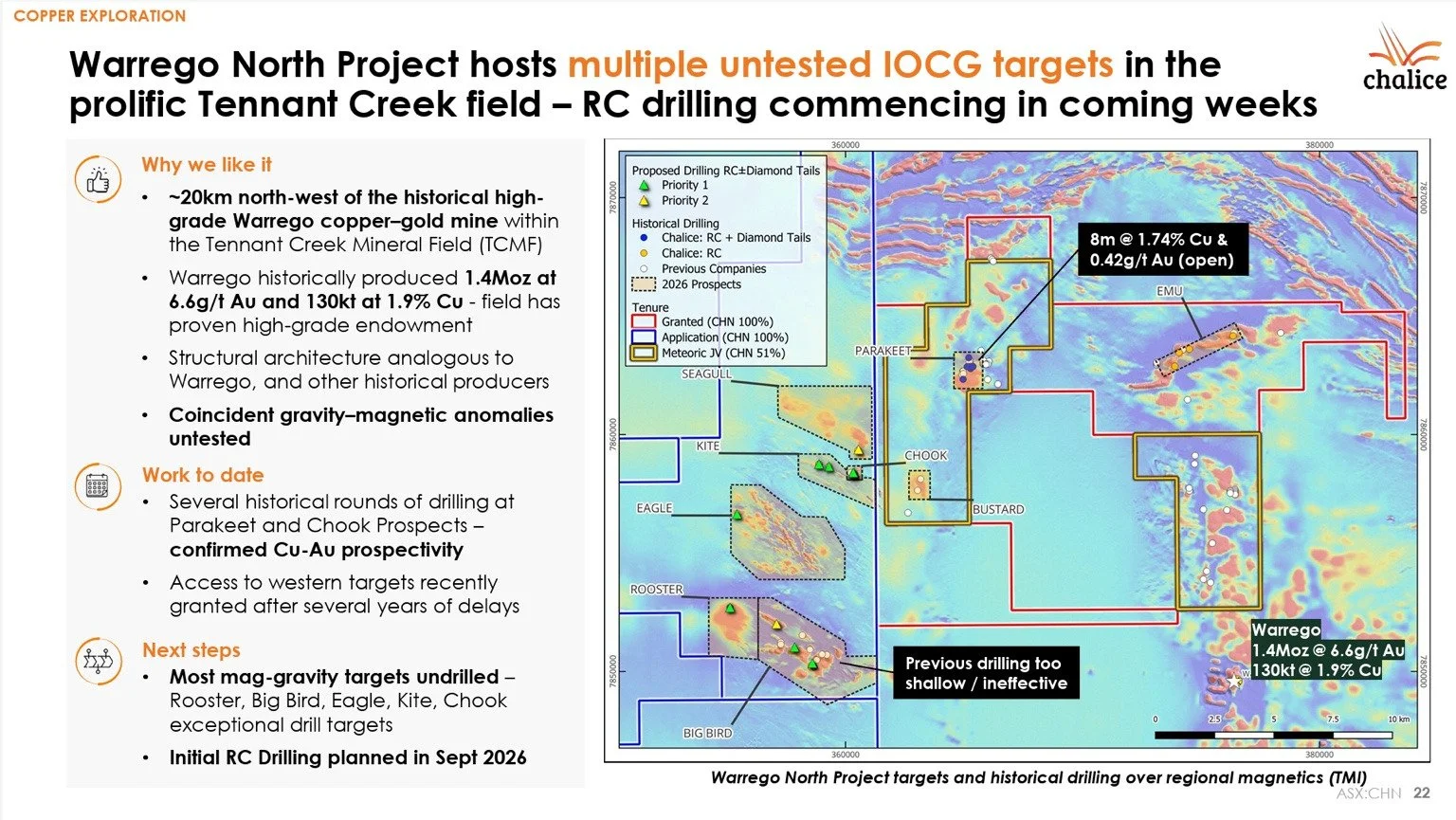
Chalice is also drilling potentially high-grade copper and gold targets at the ‘Chook’ and ‘Kite’ prospects in Australia’s Northern Territory. It took Chalice ten years to get agreement with the locals to drill these targets. I admire persistence!
Chalice once commanded an A$2.4 billion market capitalisation, six times higher than today, albeit at higher palladium prices.
Chalice is currently drilling at it’s “Warrego North” Project in the Northern Territory which is in Australia’s remote far north. Note the historical mined grades at the neighboring historical Warrego mined by Normandy: 1.4 million ounces of gold at 6.6g/t gold and 130,000 tonnes of copper at 1.9%, mined in the 1990s.
Chalice shareholders therefore get an out-of-the-money call option on palladium, plus a well-funded, high-impact copper and gold exploration lottery ticket with a proven team.
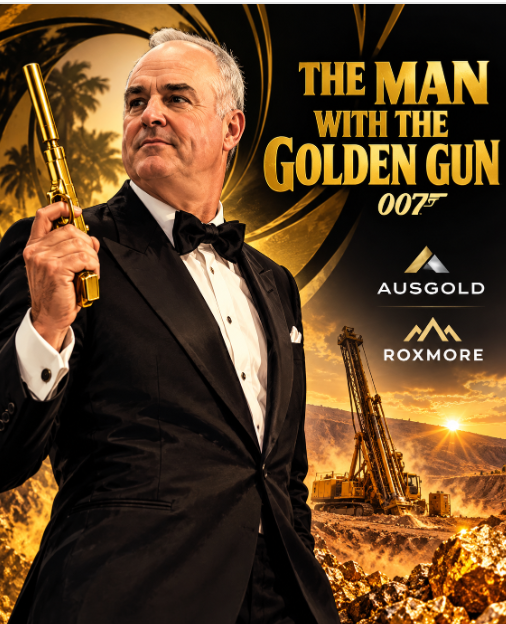
The Man with the Golden Gun
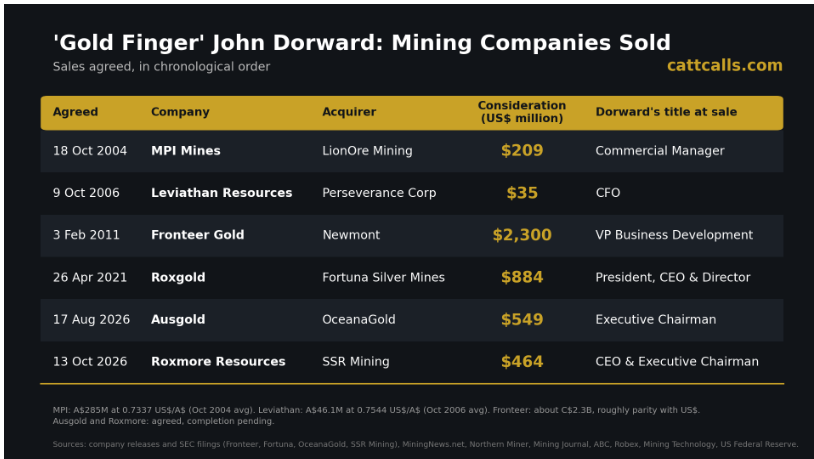
John Dorward, Executive Chairman of both Ausgold Limited (AUX:ASX) and Roxmore Resources, announced this week that Roxmore Resources (RM:TSX) was being acquired by SSR Mining (SSRM:TSX) for C$663 million (US$464 million).
Two months ago, on 14 August, it was announced that OceanaGold (OGC:TSX) was paying A$776 million (US$549 million) for Ausgold Ltd.
John Dorward is Executive Chairman of both Roxmore and Ausgold.
Roxmore and Ausgold are, in fact, only two of six companies Dorward has ‘sold’ over twenty years in the business. You could make a career out of backing John! Here is his remarkable scorecard:
What John Dorward looks for in a gold mine
In this week’s Cattcall interview, Dorward discusses how scale, jurisdiction and, usually, a market misconception create opportunity by mispricing an asset.
In the case of Ausgold, Australian investors could not see how Ausgold could resolve a dispute with a local farmer whose farm was situated on top of the Katanning Gold Project. Arlington advised Ausgold and happily invested alongside major shareholder Dundee Corporation. John discusses how the endorsement of the evergreen industry legend Julian Barnes of Dundee was important for his due diligence on Ausgold’s Katanning Gold Project.
If you are wondering what assets or companies fit the ‘Dorward paradigm’ John discusses how he always liked the ‘bridesmaid’ Northumberland gold asset, which was Fronteer Gold’s No. 2 asset behind Long Canyon. John was VP of Corporate Development at Fronteer.
Newmont paid US$2.3 billion for Fronteer Gold in 2011 and put Long Canyon into production. The Northumberland project received little attention from Newmont.
Arlington advised TSX-listed StrikePoint Gold (SKP:TSX) on the recent C$190 million equity raise to buy Northumberland from Newmont for US$70 million plus additional deferred consideration of US$50 million. I continue to buy StrikePoint shares, which, at US$15 enterprise value per ounce, are currently receiving a ‘bridesmaid’ valuation.
StrikePoint closed the Northumberland acquisition only two weeks ago and has already secured two drill rigs. Given how busy rigs and drill crews are in Nevada that speaks to CEO Mike Allen’s experience and connections in Nevada.
As Dorward says in this week’s interview, there are some metallurgical questions to answer at Northumberland. StrikePoint’s Chairman, Alan Pangbourne, trained as a metallurgist at The West Australian School of Mines and built half a dozen mines for BHP plus half a dozen more including as COO at SSR Mining.
Alan Pangbourne is a board member and leads the technical committee at OceanaGold, yes the very same OceanaGold that just bought Dorward’s Ausgold!
We await metallurgical test work on StrikePoint’s new Northumberland drill cores to understand recoveries and, consequently, the likely capex and opex for this growing 4 million ounce orebody in America’s No 1 mining jurisdiction.
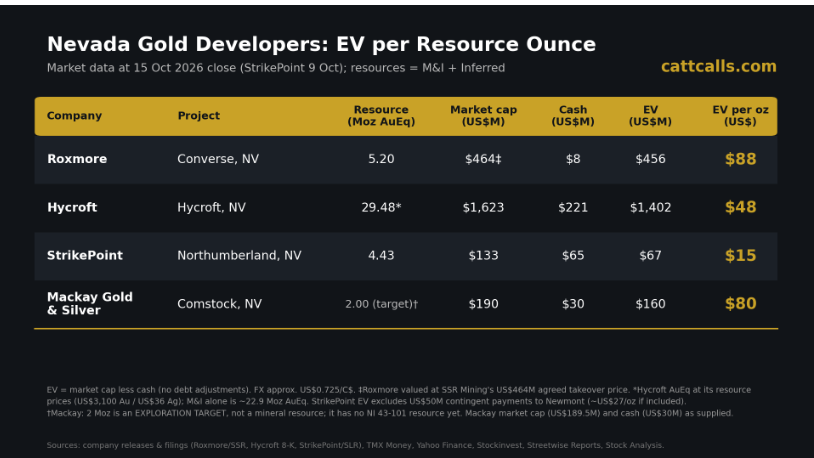
In the table above, I have used the lower end of Mackay’s two-to-three-million-ounce exploration target at their Comstock Lode. Mackay are drilling ahead now with two drill rigs and are well funded with US$30 million cash on one of the most famous pieces of United States precious metal real estate. I am a shareholder of Mackay.
Here is Mackay Gold & Silver CEO Darwin Green on site at the Comstock Lode with your correspondent last month, explaining the goals of the current exploration programme:
Hycroft Mining (HYMC:NASDAQ) has just announced its best drill hole ever in over forty years of mining history, with a spectacular 19.6 metres at 30.49 g/t gold and 1,726.72 g/t silver drilled at its Vortex orebody, which sits underneath the United States’ largest undeveloped gold and silver resource. I am a shareholder of Hycroft.
The grade of this intercept, reminiscent of Franco-Nevada’s Ken Snyder Mine, has the gold industry watching closely.
The Ken Snyder Mine’s mineable reserve in 1998, when it commenced production, was 2.73 million tons grading 1.115 oz/t (34.68 g/t) gold and 12.82 oz/t (398.70 g/t) silver, containing about 3.04 million ounces of gold and 35 million ounces of silver (or approximately 3.74 million gold-equivalent ounces).
Catt Call
Reflecting on John Dorward, aka The Man with the Golden Gun’s advice investors must ask themselves whether their mining investments are scaleable, in decent jurisdictions, the right price with experienced teams.
I think StrikePoint, Mackay, Hycroft and Chalice all fit this description.
And how totally awesome is the new Tesla Roadster Rocketship?!